
At Innovative Global Learning Solutions LLC, we make learning stick — and actually enjoyable and transformational! With over 15 years of experience in training development and instructional design, we help organizations boost the performance of their people — from staff to teams to the communities they serve —
by creating engaging, customized training solutions that deliver real results.
Struggling to Keep Your Learners Engaged
from Start to Finish?
Is your training missing the mark? Are your sessions packed with information—but somehow still not leading to real practice, application, and performance improvement?
You’re not alone.
After more than a decade of designing, developing and facilitating training with trainers, HR leaders, non-profit directors, farmers, and entrepreneurs across Latin America & the Carribean, Africa, Afghanistan, and the United States, I’ve seen it time and time again: great content falling flat because it lacks the spark to truly connect with learners.
That’s why I’ve pulled together a go-to collection of my favorite training activities—the ones I use again and again to energize sessions, spark discovery, and drive real-world application. Whether you’re opening a session, building engagement, reinforcing key skills, or closing strong, this resource is packed with practical tools to help you design training that sticks.
Most of these activities are designed for live delivery, whether in-person or virtual, and can be adapted to different topics and audiences. If you’re a facilitator, HR leader, or L&D professional looking to bring more energy, relevance, and impact to your learning experiences—this is for you.
Form to download the go-to collection of my favorite training activities:
Trainer’s Go-To Guide: High-Impact Activities to Engage, Practice & Apply
Below are a list of my favorite high-impact activities to engage, practice, and apply.
The activities are broken down into four categories:

Opening Activities

Discovery Activities

Practice/
Application Activities

Closing
Activities
Opening activities provide participants with an opportunity to reflect on their own goals and objectives, connect with the benefits of what they will learn, and review any content from the previous module or day.
● Symbol cards or picture cards: Participants select one or two symbols and share what excites them or what they find challenging about a given topic.
● Drawing pictures or murals can be a powerful tool to help people connect to what they already know and to the importance of or what excites them about a topic. You can ask participants to draw their vision for their career and what they want to achieve. Examples include drawing a successful trainer, leader, or manager, etc.
● Goal setting: Participants reflect, write down, and share what their goals are (the skills they hope to develop, what they hope to achieve) as a result of the training.
● Poster Walk: Participants take a walk around the room with a partner, look at the posters, and discuss how the poster relates to their learning. This activity is typically used to review or reinforce material from a previous day or module.
● Flipchart Review Activity: The facilitator makes 5-6 flipcharts with different review questions (i.e. what are three learning styles? What are the characteristics of adult learning?, etc.) and hangs them up around the room. Participants form groups of 3, start at one flipchart, discuss and write down their ideas, and then rotate until all groups have reviewed and added comments to each of the flipcharts.
● Icebreaker Introduction: Participants form a circle. One person starts by stating their name and sharing one interesting thing about themselves or anything related to the content of the training. (i.e., My name is Meena and I have been playing the piano since I was three). The second person must repeat the first person’s name and what they said, and then add their own name and one thing about themselves or related to the content of the training. (i.e. Her name is Meena and she has been playing the piano since she was three. My name is Jonathan, and my goal is to own a website design business). Each person in the circle repeats the information of the person before them and adds information about themselves.
● Jeopardy: To review prior material, think of four categories that you want the participants to test their knowledge. Create 3 or 4 questions on the most important topics in each category. Write each question on an 8X11 sheet of paper or on PowerPoint, and assign a point/monetary value to each question. Divide into groups of 3 or 4 people, and have them create a team name. Give each group a turn to select a category and answer the questions. The team with the most points at the end wins.
● Find Someone Who: Participants receive a handout with statements/facts and must find other participants who identify with each one. The person who completes their handout first wins.
● Interconnected Web: Participants form a circle. One person starts with a ball of yarn, introduces themselves and shares a skill or experience related to the training, holds onto the end, and then tosses the ball to another participant. This repeats until all participants have shared and are connected by a web of yarn. The facilitator reflects on the shared expertise and how it all connects in the training session.
Discover activities enable participants to learn the new content and key concepts. They allow learners to interact with new material and with one another.
● Learning stations are used to aid participants to discover new material and teach it back to other participants. It’s a very powerful method because it puts the learning in the hands of the participants and the facilitator is there to assist and support. Learning stations are designated tables or spaces set up in the training venue where small groups can meet and use learning aids, such as posters, case studies, articles, photos, to teach themselves about the new content. You can use learning stations to allow participants to discover various finance forms, parts of project life cycle, leadership characteristics, etc. You can have small groups rotate from station to station to learn new materials.
● Personifying content is a fun and memorable way to help participants discover new material. For example, participants can become the phases of the project cycle or marketing concepts. Participants can pretend they are business or financial terms and introduce themselves to one another to learn definitions. Usually, cards or pictures of the activities, terms, or processes are created and used for the personification.
● Case studies are scenarios that apply concepts learned in class to a “real-life” situation. They are usually presented in narrative form and often involve problem-solving, linking to course readings or source materials, and small-group discussions. Typically, case studies are most effective when presented sequentially, allowing participants to receive additional information as the case unfolds and continue to analyze or critique the situation or problem.
Guiding questions lead participants through the activity to stimulate their critical thinking. Example questions include:
● What is the situation? What questions do you have?
● What problem(s) need to be solved? What are possible solutions? Evaluate pros/cons of the possible solutions.
● What information do you need? Where/how could you find it?
Practice activities enable participants to test out their new skills and abilities so they can receive feedback in a safe learning environment.
● Debate: Engagement in a collaborative discourse on a topic enhances the participants’ understanding. Stage a debate regarding the topics or session materials. Give teams time to prepare their discourse/argument, and then put them into a debate with another team representing an opposing viewpoint.
● Role Play: Participants form groups and develop a role-play or skit to demonstrate the knowledge and skills they have learned. Each group member plays a specific role, acts out the role play to other team members, and receives feedback. Advantages include motivation to solve a problem, providing a new perspective through which participants can explore or understand an issue, and develop skills.`
● Jigsaw: A Jigsaw is a cooperative active learning exercise where participants are grouped into teams to solve a problem or analyze a reading. In a jigsaw, participants are divided into two groups: a home group, in which each participant is assigned a different topic to learn about and teach back to the group, and a topic group, in which all the participants are learning and preparing about the specific topic together to present back to their home groups. Each person in the home group teaches the rest of the group what they know, and the group then tackles an assignment together that pulls all the pieces together to form the full picture, hence the name jigsaw.
Closing activities give participants an opportunity to reflect on what they have learned and plan how they will apply their new knowledge and skills.
● Dancing Circles: Participants form an inner and outer circle and start dancing in opposite directions when the music starts. When the music stops, the participants must find a partner and share a key learning, insight, or one thing they plan to do as a result of what they learned.
● Persuasion Role Play: Participants divide into pairs. One person plays the role of a colleague or neighbor. The other person must convince the colleague or neighbor of the importance of the new knowledge and skills they have learned (i.e,. using a competency-based design process, creating budget projections, etc.). Then, the pairs switch roles. This closing activity helps participants synthesize what they have learned and communicate it effectively to another person.
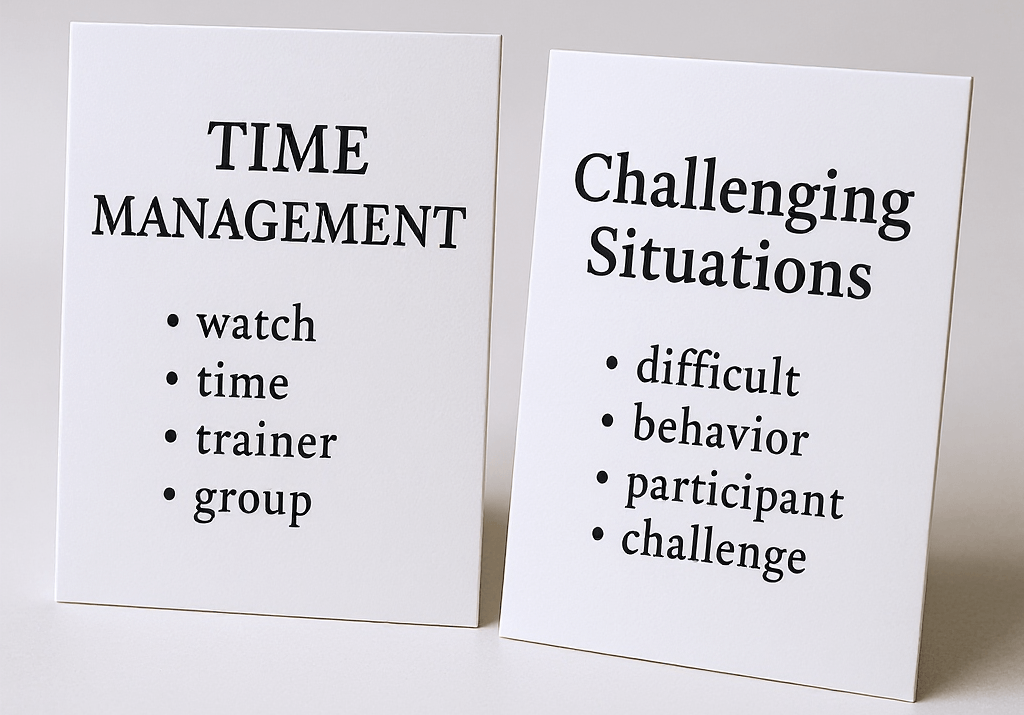
● Taboo Review: The Facilitator creates cards with keywords related to the training. Participants must form two groups, and one group will begin by explaining the key word on the card, and the other group must guess the correct word. Each group receives a point for the words they guessed correctly. The team with the most points wins.
● Oksukarasame—Japanese Ritual: Participants form a circle and each person will say one thing either about what they learned, what they appreciate or what they will apply as a result of the training, and everyone will put their hands together, bow, and say Oksukarasame (which means that we are honorably exhausted).
● Picture Summary: Divide participants into small groups and give each a flip chart or flip chart sheet. Their task is to design a poster that summarizes the key points they’ve learned. There are 4 rules: 1) page limit is one sheet of paper; 2) only pictures can be used, which includes 5 graphics, symbols, icons, or diagrams but not words, letters or numbers; 3) joint effort, meaning that all team members should contribute; and 4) time limit is 5 minutes.
Example of a Symbol Card Activity
in a Facilitator’s Guide
Symbol/Picture Cards can be used in a variety of ways to help people prepare to learn. They can be used as a tool for participants to reflect on their thoughts and feelings about the topic, what excites, motivates, and challenges them. Often metaphors and pictures help people to express themselves in a richer way than words. You can ask participants to select a card that represents a challenges they faces in a training, at work, etc, or a picture which represents what excites him/her about facilitation, a symbol that represents what feedback is like, etc.
▶ ARRANGE the picture cards on the ground or on the table in a way that allows everyone to see all the photos.
▶ ASK participants to think about their existing experiences in training or the things they look forward to as a future facilitator.
▶ ASK participants to choose two symbol cards that represent:
1. Something exciting related to training
2. Something you find challenging related to training
▶ ASK participants to share their cards with a neighbor.
▶ ALLOW pairs 5 minutes to explain why they chose each of the pictures and what it represents to them.
▶ INVITE 3-4 volunteers to share their pictures with the group.


Example of a Personification Activity in a Facilitator’s Guide
Personifying content is a fun and memorable way to help participants discover new material. Participants can pretend they are business or financial terms and introduce themselves to one another to learn definitions. Usually, cards or pictures of the activities, terms, or process are created and used for the personification.
ACTIVITY: COMPETENCY-BASED TRAINING DESIGN PROCESS
ASK for 9 volunteers to become the steps of the competency-based training design process.
HANDOUT a step to each of the participants. The activity cards should read:
● Conduct a Performance Analysis
● Determine Learning Objectives
● Determine Assessment Method for Objectives
● Determine Best Delivery Method
● Map Content and Plan Learning Activities
● Identify Resources Needed
● Develop Training Materials
● Implementation
● Evaluation
EXPLAIN: Each volunteer has been given an activity that represents one of the steps in the design process. You will be that step and decide where you fit in the design process
ASK participants form a horizontal line and put yourselves in order from Step 1 to Step 9.
INVITE each volunteer to present themselves as the Step and ask them to give more information on what they do in the design process.
ASK the other participants if the order is correct and if there is anything they would like to add.


Example of a Jigsaw Activity in a Facilitator’s Guide
Jigsaw is a cooperative active learning exercise where participants are grouped into teams to solve a problem or analyze a reading. In a jigsaw, participants are divided into two groups: a home group, in which each participant is assigned a different topic to learn about and teach back to the group, and a topic group, in which all the participants are learning and preparing about the specific topic together to present back to their home groups.
ACTIVITY: LEARNING STYLES JIGSAW
SAY SOMETHING LIKE…You will now have the opportunity to explore the three learning styles in depth and determine how to incorporate all of them into your facilitation.
DIVIDE participants into groups of 3.
EXPLAIN: These groups will be your HOME groups.
ASK each HOME group to count off 1-3 within their group and break away to join others with their number.
ASSIGN each number a learning style to review:
● Visual Learner
● Auditory Learner
● Kinesthetic Learner
EXPLAIN: Each of you will have some time to explore your assigned learning style and answer the following questions:
● What types of activities and methods helps your assigned learning style learn best?
● How does this preferred learning style influence your facilitation?
Please turn to page X in your workbook to read more about it, see explores, and take notes.
GIVE groups 10 minutes for the discussion.
ASK participants to return to their HOME groups and take turns presenting the key points of their assigned learning style to the rest of their group.
ALLOW groups 15 minutes to share.
ASK everyone to return to the large group.

Example of a Taboo Activity in a Facilitator’s Guide
FORM groups of 5-6 participants.
EXPLAIN that each group will select a Taboo card when it is their turn. Each Taboo card has one “secret” word and four or five “taboo” words. Only one person on the team will see the taboo card, and he/she has to describe the secret word without using any of the taboo words to his/her team. If the team guesses the secret word, they get one point. The team with the most points at the end gets a piece of candy.
SHOW an example.
DO activity for 10-15 min.
KEEP track of the points for each team.
GIVE the winning team candy as their prize
If you'd like a free 20-minute consult to walk through your current project,
book with us right here:
 Hi! I have a free 20-min consultation to walk through your current project.
You can schedule your time with me right here!